
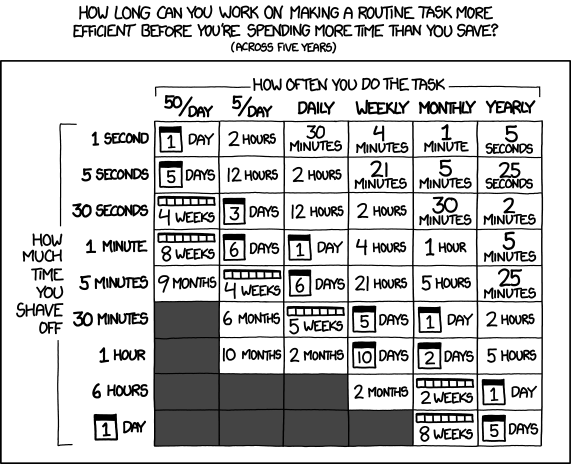
I spent last weekend automating a task that would take me five minutes once a week. It reminds me of the classic XKCD comics on Efficiency and Automation.
The goal was “write once, publish everywhere.” I prefer writing on my own blog, but once I publish, I want to share that content across platforms like X and LinkedIn. I was curious if I could use AI to automate this—specifically by acting on my behalf, opening a browser, and posting. Thus, the project commenced.
You can find the end result here: github.com/abhirama/ghost-ride.
The utility leverages Claude Code’s browser navigation capabilities to post blog content directly to social media.
Some Reflections
The Joy of the “Pointless”
This is a small experimental project, but there is an innate joy in building things. Every time I work on a personal project like this, I feel immense satisfaction. It reminds me of the concept of “Flow”—that state of total immersion where the challenge perfectly matches your skill level.
Much of my evolution as a programmer has resulted from these throwaway experiments. It’s a reminder of Steve Jobs’ “Connecting the Dots” philosophy—you never quite know how the skills from a weekend project will pay off later.
The Speed of AI
AI is surprisingly slow when mimicking a human user. I spent the majority of my time testing the tool, which involved painfully waiting for Claude to open Chrome, navigate to the sites, and type out the content.
“Vibe Coding” Still Requires Direction
I “vibe coded” most of this. Even for a small hobby project, it still required significant prompting and instruction to get it right.
The Complexity of Polish
Creating software is becoming easy and will soon be commoditized. However, creating awesome software that handles every edge case remains difficult. It’s a classic case of the Ninety-Ninety rule: the first 90% was a breeze with AI, but that final 10% of polish is where the real engineering (and most of the time) lives. Regardless, AI makes it incredibly easy to start, prototype, and validate ideas.
 Abhirama's Blog